
Monday, November 28, 2011
Winter tree inspections
Over the last few days the tree team at Bedgebury have been carrying out tree safety inspections around the Pinetum. These inspections are carried out in what we call "high profile areas", and we monitor the trees for things like dead wood in the crowns, posible decay, trees blow over in the wind and hung up branches. Once these inspections are completed the work is prioritised and carried out accordingly to ensure the trees are kept in good health and the public in a safe enviroment. Written by Kevin Cooper of the Bedgebury Tree Team.
Friday, October 28, 2011
Seeds Arrive
 Autumn is a busy time in the nursery, now is the perfect time for taking semi-ripe cuttings of conifers and it also the time to be collecting seed. We have had our first batch in this year from a joint expedition between Wakehurst Place and our sister collection Westonbirt Arboretum to Japan. We are eagerlly awaiting seeds from Californina, Lebanon and the high mountains of El Salvador. These will all be grown on in the nursery for a few years before being planted out in the collection.

Autumn Views


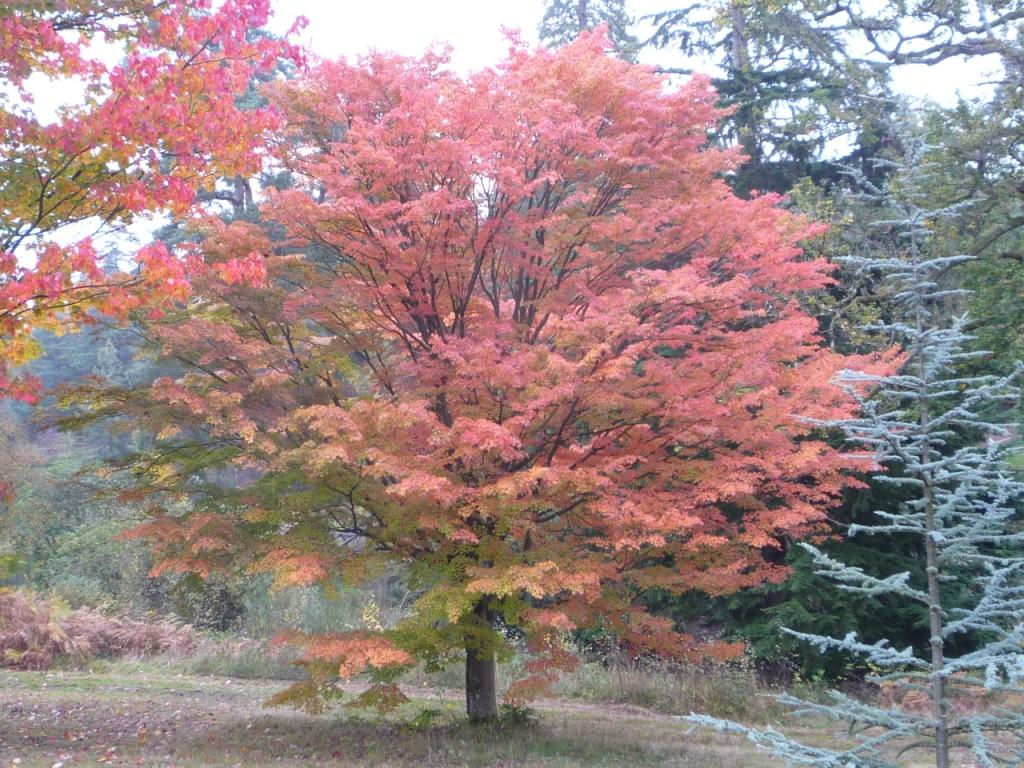
The weather this week has been over cast and grey but the autumn colour is still looking amazing and the colours really stand out amoungst the conifers. The top picture is the view across Marshalls lake (from e12) looking at the fantastic stand of Swamp Cypress and Dawn Redwoods, the Swamp Cypress are turning there lovely rusty brown and soon the Dawn Redwoods will start to turn a tawny pinky brown. These are unusual as the are deciduous conifers!
The next 3 photos are taken on G11, G12. H11, H12 there are a number of Acer species growing amoungst the Fir and Cedar trees and is looking at its best right now.
Monday, October 17, 2011
Berries


There are lots of lovely berries to look at around the Pinetum providing the local wildlife with food over the coming months a few to look out for are (top to bottom) Sorbus maderensis H9(critically endangered from Madeira), Sorbus commixta I8 (Japan, Sakhalin and Korea) and the golden fruited yew Taxus baccata 'Lutea' I14
Pseudolarix amabilis


Most conifers are evergreen like Pines, Spruce, Fir and the dreaded Leylandii a few however are deciduous and they have fantastic autumn colour one of our favourites is the Golden Larch Pseudolarix amabilis from Eastern China where it is endangered due to logging and land being cleared for agriculture and housing. In December Dan was lucky enough to go to Tianmu Shan one of the few remaining area where it grows "wild" (bottom picture). In China it can reach over 50m tall with a dead straight trunk, howere in the UK it is usually only seen as a small tiered tree. The grass green needles start to turn around the middle of October to a beautiful golden yellow (top picture) before falling to the ground a few weeks later. We have two good specimens planted in 1950 these can be found in I11.
Pine Cones


Autumn is also a good time to look out for cones, across the Pinetum you can find them in varying shapes and sizes ranging from tiny cones the size of a penny on Larix laracina to some of the more impressive Pine cones like those of Pinus armandii (top) and Pinus x holfordiana (middle) both of these trees are absolutely covered with cones at the moment, the best place to see these are on the bank opposite the visitor centre (L6). Slightly smaller but just as interesting are the cones on Picea obovata down in Dallimore Valley (H9).
Autumn Leaves


The deciduous trees are still putting on a wonderful show some of this weeks best top to bottom are Fothergilla major (map location G9), Liquidambar styraciflua (the best ones are in H9) and Acer japonicum 'Vitifolium' (I13)
Friday, September 30, 2011


This week has seen some of the best weather we have had since early summer. The Pinetum is looking stunning in the unexpected sunshine the autumn colour is holding well. The top photo is Betula lenta the Cherry Birch from E USA this tree was planted in 2006 this tree can be seen on the bank over the lake from the visitor centre. The middle photo is of Rhus trichocarpa with its fantastic deep orangey red autumn colour, it makes a fantastic small shrubby tree unfortunately the sap can be irritant to some people so look but dont touch! See F10 It is a native of eastern Asia, this plant was collected from the wilds of Japan. The bottom picture is the leaf of Acer rubrum the Red or Canadian Maple this beautiful colouring maple is from the eastern USA and eventually makes a large tree for the smaller garden a better option would be one of the Japanese maples. The best examples are in I12
Tuesday, September 20, 2011
The Katsura Tree


Some of the best autumn displays have already begun, the Katsura Tree Cercidiphyllum japonicum is looking stunning at the moment its beautiful heart shaped leaves turn different shades of yellow, orange, red and purple. On top of this the leaves as they fall on to the ground give off a wonderful smell of candy floss. In the UK it is a small to medium sized bushy tree but in its natural habit in China and Japan it can reach over 45m! That is nearly as tall as the Old Man of Kent. The best examples in the Pinetum are in grids (click of the Bedgebury Pinetum map at the top of the page) G8 below the Leyland hedge and in K5 on the bank opposite the visitor centre.
Autumn Has Started

We have had some strong winds recently with gusts to 70mph. Fortunately no trees have been blown down but we have lost a few large branches. Have you noticed the nights drawing in and the temperatures dropping putting a chill in the air? These changes herald the arrival of autumn and this year looks good for a beautiful show of autumn leaf colour. Some of the wild flowers are still looking their best. One of the stars at Bedgebury is Devil's-bit Scabious 'Succisa pratensis' growing in large areas under the conifers across the site. Look out for the round bluish purple rounded flower heads nodding on long stalks; it is a good source of food for bees and butterflies. It gets its common name Devil’s-bit Scabious because its roots stop abruptly as if they have been bitten off. The plant was used to cure almost anything, so the Devil got angry with it. He bit off the root out of spite.
Tuesday, September 6, 2011


Thursday, April 29, 2010
Spring bursts into life at Bedgebury
After the tough winter, Bedgebury at last is coming into full bloom. Here's a taste of what's looking good.


Monday, January 4, 2010


Monday, November 30, 2009
Bedgebury prepares for winter

Winter colour in the dwarfs by the dog kennel.

Tiny fungi growing on one of the smallest of our NCCPG National Collections of Lawson Cypress. This one is called Chamaecyparis lawsonian 'Green Globe'. It was grown as a cutting in 1980 and is no bigger than a football even now. You can find it next to the gate by the dog kennel.

Spiders webs on the dwarf Picea abies next to the pond up from Marshall's Lake.

Beautiful white buds on Pinus thunbergii 'Thunder Head' at the end of Lady Mildred's Carriageway.

This Viburnum farreri at the end of Lady Mildred's Carriageway flowers in winter on naked stems and they are beautifully scented - have a sniff.
Wednesday, November 4, 2009
Towards the end of autumn

A blaze of rich autumn colour on Acer palmatum 'Coonara Pygmy' - an excellent compact form of the Japanese Maple.

Tree team member Sean Lewis flail collecting. This is done each year towards the end of autumn to encourage the growth of wild flowers.

Bedgebury Pinetum is the holder of the NCCCPG Yew Collection. This tree (Taxus baccata 'Fructo Lutea') is the golden-fruited form of our native yew.

Pedro Leo Lobos, curator of the National Seed Bank in Chile, standing alongside a young Fitzroya cupressoides (Alerce). Pedro was in charge of our expedition to Chile, so it was great to be able to show him some of the conservation work we undertake at Bedgebury.

Autumn colour in Dallimore Valley

Male cones on the Deodar (Cedrus deodara) releasing the pollen that will fertilise next year's cones.

A good crop of holly berries. These will provide a valuable food source for many of Bedgebury's feathered friends over the winter months.

A fantastic range of colours produced by the leaves of the Sweet Gum (Liquidambar styraciflua) which is often confused with the maple tree. It differes in having corky bark and the branches are alternate rather than opposite. Also, unlike maples, it doesn't have winged fruits.

A lovely specimen of the Sweet Gum (Liquidambar styraciflua) in full autumn colour in Dallimore Valley (just down from the Wellingtonias).

The golden yellow Ginkgo leaves are looking amazing at the moment. The Ginkgo originates in China, but we don't know whether it still occurs in the wild. On our trip to China in 2008 we saw some fantastic specimens planted in the grounds of monestaries. It is one of the most pollution-tolerant trees, commonly planted as a street tree around the world. These are almost always male trees, however, as the fruits on the female trees smell absolutely disgusting!!! Ginkgo can grow to a massive size, but there are now dwarf and slow-growing varieties ideal for the garden.

One of the young Ginkgos growing in Dallimore Valley. The largest specimens we have are growing in the area between the dwarf conifer collection and the Glory Hole.

Witch hazel (Hamamelis virginiana) flowers in winter.
Subscribe to:
Posts (Atom)